Lawrence Huntington
Excerpt from Great Expectations: British Postwar Cinema 1945 – 1960

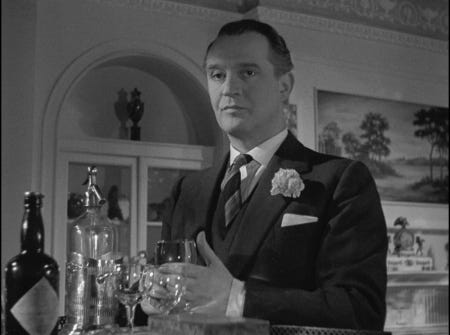
Today is the birthday of Eric Portman, one of British cinema’s most unusual postwar stars, with a potent attraction that was rooted in personal magnetism, not looks. One of Portman’s best roles was in Wanted for Murder (1946), directed by the chronically underrated Lawrence Huntington. It seemed as good a time as any to put my Huntington essay online. It was written for Great Expectations: British Postwar Cinema 1945 – 1960, the volume that accompanied the retrospective section at the 78th Locarno Film Festival. The book was edited by the section’s programmer, Ehsan Khoshbakht; here my brief essay is published online for the first and only time.
Lawrence Huntington directed his first film in 1930, at the start of the talkie era, and his career as a genre specialist grew through the 1930s and into the war years. But the best of his work came in the immediate postwar period, starting roughly with the efficient spy thriller Night Boat to Dublin in 1946, and continuing through The Franchise Affair in 1951. Often brushed aside as a workhorse, the movies from this period show Huntington was in fact a highly effective stylist. Within a single film, he could glide from English good manners and drawing-room propriety, to criminality and unsettling violence.
Nowhere is this more clear than in Wanted for Murder, a bland title for a brilliant 1946 yarn. Emeric Pressburger and Rodney Ackland’s script, adapted from a stage play, concerns Victor Colebrooke, played by Eric Portman, British film’s reigning specialist in sinister. Colebrooke is the grandson of Queen Victoria’s chief hangman. Nature (a strangling compulsion present from birth) and nurture (misogyny blamed on his stifling mother—“you’ve always kept him under a glass case,” says a visitor) have turned Colebrooke into a serial killer, to use the modern term. A real serial killer rarely has or needs much explanation, but the seesaw of Colebrooke’s genteel exterior and his dark, vicious soul gives Wanted for Murder its impact.
It’s hard not to conclude that Alfred Hitchcock must have seen Wanted for Murder, given (among other points) the similarities between the fairground climax of Strangers on a Train (1951), and Huntington’s crowded, menacing scenes at a carnival. As Colebrooke slinks around the rides and the tents, it’s obvious that if the movie’s heroine Anne (Dulcie Gray) hadn’t been delayed in the first scene, she would be his next victim: he even picks a woman who resembles Anne.
Huntington’s camera informs with angles and lighting; even Colebrooke’s back, the first time he’s shown, looks psycho. A murder in Regent’s Park happens while Colebrooke’s lovestruck prey has her head in his lap. The camera lingers on Colebrooke’s face looking down, framed by leaves and branches, as he listens to the poor girl sing—until she stops mid-note. These shadowy cold-blooded moments offset the spacious Scotland Yard office and deadpan banter of Chief Inspector Conway (Ronald Culver) and his sidekick Sergeant Sullivan (Stanley Holloway), until the hunt closes in on an island for pleasure boats—another idea Hitchcock may have noted.
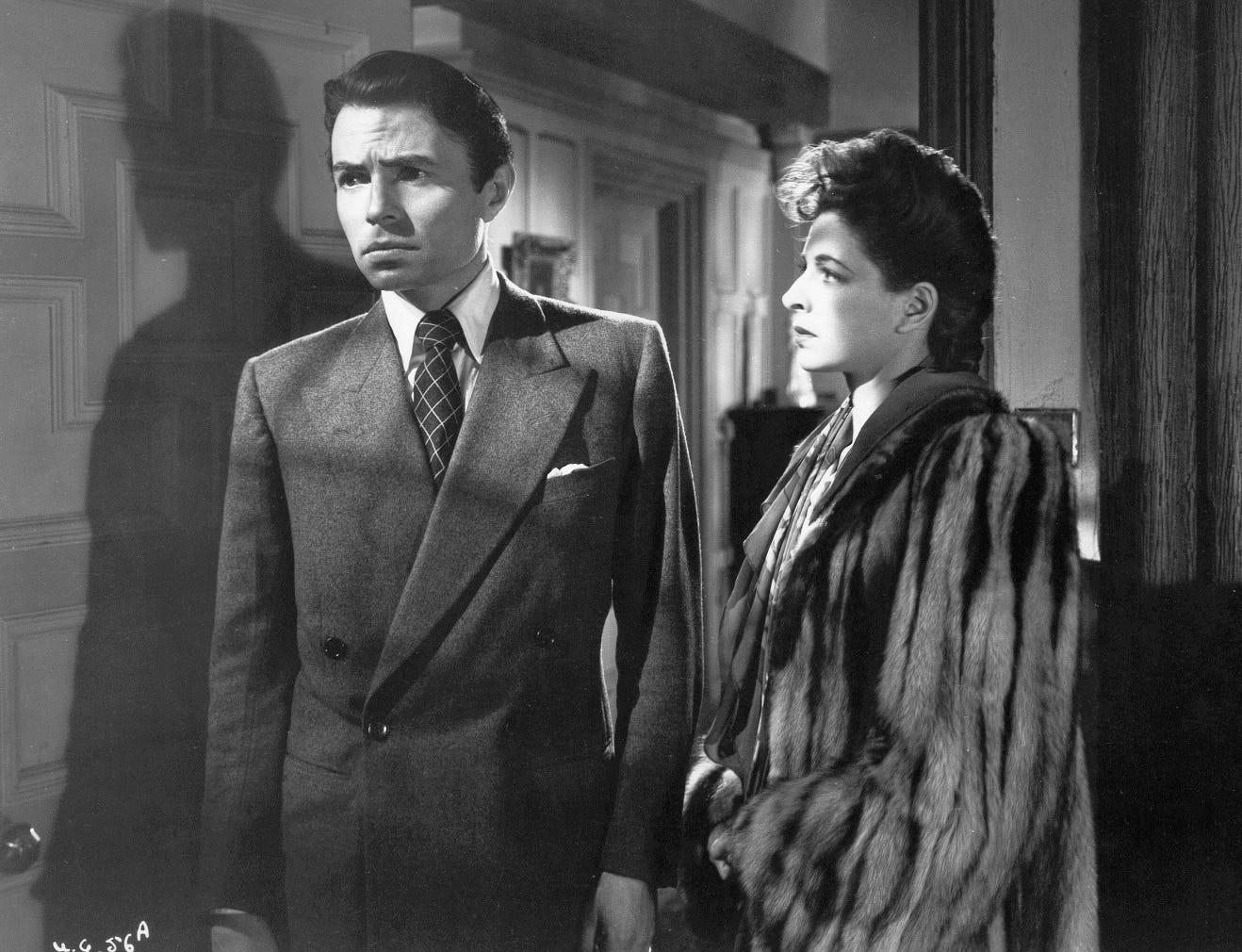
The Upturned Glass (1947) is an even more unusual specimen. It starts with a lecture by famed neurosurgeon Michael Joyce (James Mason) on abnormal psychology, then proceeds with the swoony romance between Michael and his young patient’s mother (Rosamond John). Both are married to others—unhappily, of course. All this is filmed with smooth refinement, until the day Michael’s love, in a most suspicious development, falls from an open window in her home. That point marks the arrival of Pamela Kellino (co-screenwriter and Mason’s wife) as Kate, the sister-in-law who probably did it. Here, the look and atmosphere of The Upturned Glass goes delightfully berserk. The surgeon begins to woo the murderess, meeting her first at a posh cocktail party where Huntington’s camera weaves through the crowd with Michael. As a courtship ensues, Kate—who is one snobbish, greedy, overdressed piece of work—is shown in montage against a black background, emphasizing all the reasons Michael wants her dead. (So does the audience, probably.) The inevitable murder finds the camera chasing both Michael and a shrieking Kate—twice, for structural reasons that shouldn’t be spoiled.
Far less flashy, but no less worthwhile, is 1949’s Mr. Perrin and Mr. Traill, adapted from a 1911 Hugh Walpole novel. Mr. Perrin (Marius Goring) is a long-serving schoolmaster at Banfield, one of those terrifying English boarding schools for boys. He finds himself consumed by jealousy of Mr. Traill, the younger hire played by ever-virile David Farrar. Walpole’s story was brought up to date for the film, with the war over and unspoken resentment lingering between those who went off to fight (Traill) and those who didn’t (Perrin).
Banfield at least is gorgeous, located in Cornwall in a Manderley-like building close by picturesque oceanside cliffs. Still, it’s plain the staff are miserable; Traill is informed by one of them that Banfield is “like a decaying tooth. It doesn’t trouble you much after the nerve goes.” Perrin blames the handsome, athletic (and, for a while, oblivious) Mr. Traill for his troubles, but Perrin’s dreams are really being crushed by headmaster “Moy” Thompson. Silkily played by Raymond Huntley, the headmaster takes evil pleasure in thwarting his underlings at every turn.
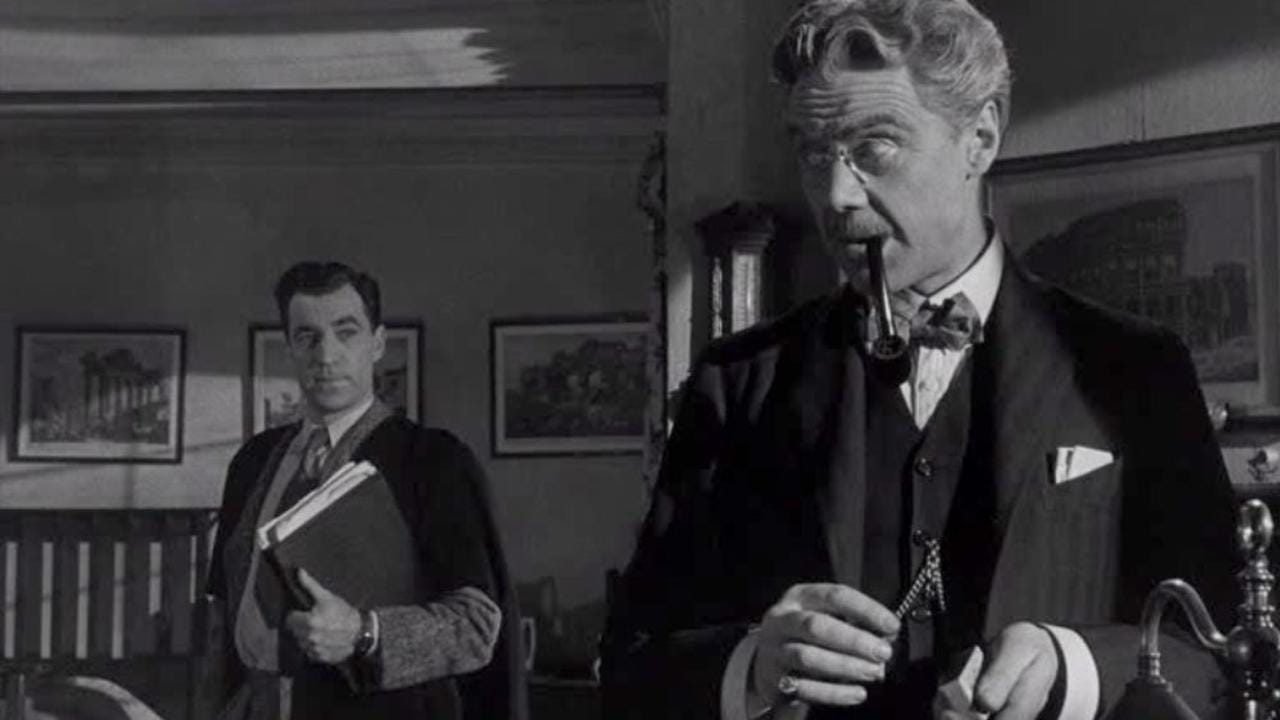
For this movie that revolves around jealousy and gossip, Huntington often frames one actor on the side and in the foreground, so as to show the other characters reacting in the back of the shot. Huntington also takes pleasure in high angles whenever Perrin looks out the window in search of Traill’s latest outrage. Huntington often seems to nod toward MGM’s 1939 Goodbye Mr. Chips. Goring, who like Chips star Robert Donat was playing a man much older than himself, is decked out with Donat’s sheepdog mustache, and even adopts some of the other actor’s spluttering mannerisms. But it’s the devastatingly sad fadeout, as direct a Chips reference as possible, that confirms we’ve been watching a rejection of Hollywood sentiment.
Mr. Perrin and Mr. Traill wasn’t Lawrence Huntington’s last film, nor his last good one. In 1951 he helmed an adaptation of Josephine Tey’s bestselling The Franchise Affair. In it, a teenage girl accuses two respectable women living in a remote country house of having kidnapped, beaten and starved her in an attempt to force her to become their servant. The movie starts on a remote highway with a wild thunderstorm, and the young girl (Ann Stephens) pops up in the middle of the road in a startling close-up. This vigorous opening, and a sequence where the outraged villagers attack the country house where they believe Betty was held, are the most visually interesting parts of the film. Otherwise, though The Franchise Affair is engrossing, Huntington is letting his cast carry it, treating them at times as though surrounded by a proscenium arch. Perhaps the British studio system was wearing down Huntington as it once had Alberto Cavalcanti and others. In any event, by 1953, Lawrence Huntington was beginning a move into television that would last until the 1960s, and his later films did not match the vivid creativity of the late 1940s.
I don't know Huntington's work at all, so thanks for this! I'll add these to The List.
Aside: my favorite Portman role is one of his last, in DEADFALL, by the strangely underrated Bryan Forbes. I discovered that one because of my John Barry obsessions, but it's a nasty little gem.
Oh, this was just superb. Thank you!