In Memoriam: Rex Reed
Serious, and also glib and readable

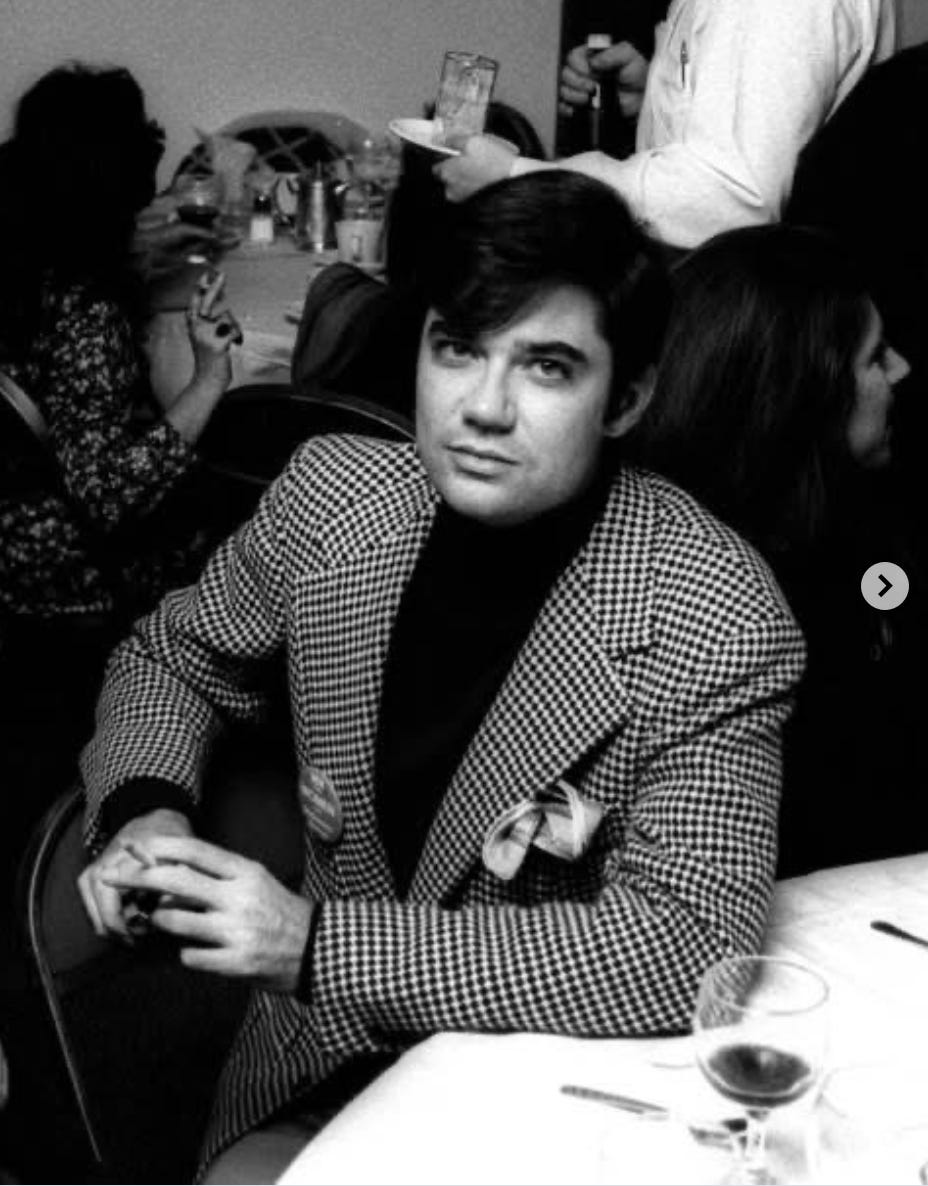
I know exactly what many people thought of the late Rex Reed. Short-tempered, careless with facts, close-minded at times. Took unseemly delight in insulting actors’ appearances. Politically incorrect (to put it politely) to an extreme, at times offensive degree. Hell, he offended me more than once.
So it’s not that I don’t share those views—all of them. It’s just that over the past few years I’ve also realized they’re not the full story of Reed. For one thing, I give him credit for not backing down an inch when it came to his point of view. That may sound like weak praise when applied to a film critic—aren’t we supposed to plant our flags? isn’t that part of the job? Well, yes, but I’ve seen some waffles, especially after a good pasting on social media. Reed—given his temperament, I think wisely—wanted nothing to do with Twitter or anything like it. But there are a lot of examples of him standing his ground elsewhere.
In the 1970s Rex Reed had a column in the Daily News in addition to his reviewing duties. I’ve had occasion to dig through a lot of them, and in addition to his justly famous interviews, those columns are some of his best work. For example: Reed loved Peter Davis’s powerful 1974 documentary Hearts and Minds, about the enormous toll of the Vietnam War. Reed proclaimed it the best movie he saw at that year’s Cannes Film Festival, but Hearts and Minds was controversial at the time, and in some quarters remains so to this day.1 Maybe you have to put yourself in the mindset of 1975—the touchiness about the war, the divide between young and old—to appreciate the savage way Rex Reed recapped the Academy Awards where Hearts and Minds won Best Documentary.2 He wrote:
When Peter Davis and [his co-producer] Burt Schneider won their highly-deserved Oscar for the magnificent documentary Hearts and Minds Schneider read a telegram from the Viet Cong as part of his acceptance speech. The audience cheered, but Bob Hope was furious. It was a political film and Mr. Schneider had a democratic right to say anything he felt like saying. It must be remembered that the telegram was a statement of friendship from the Viet Cong, not a statement of war. The next thing we knew, Frank Sinatra was reading aloud an alleged disclaimer from the Academy absolving its members from any guilt by association with any person on the show making a political remark during the telecast. The statement was greeted with boos and hisses and flying fists.3
Backstage, there was pandemonium. Where did Frank Sinatra get such a statement, Shirley MacLaine demanded.4 “I am a member of the Academy and I wasn’t offended by Burt Schneider’s acceptance speech,” she said, “so how can you read anything in the name of the Academy when its members have not approved or ratified the statement?” Sinatra said Bob Hope shoved the statement at him and demanded that he read it. Walter Mirisch, president of the Academy, said he knew nothing about it. It was a Bob Hope production from beginning to end. Hope seized the moment to get his own conservative, right-wing opinions across to 65,000,000 people and used the Academy as a cowardly shield. It was a disgraceful thing to do and the film industry is shocked to its core as a result. It serves them right. What was Bob Hope doing there anyway?
Agree or disagree, to me this is Rex Reed at his best, not giving two hoots in hell about whether he, as a movie writer with an interest in “preserving access” as we say today, was burning bridges. And in 1975, with his fame and money-making at its height, Reed had a lot to lose. The late Cari Beauchamp told me she once tried to get a well-known Oscar writer5 to take up an AMPAS topic that was burning her bacon. The reply was, “Sorry, I like going to the Oscars.”
Part of Reed’s take-no-prisoners attitude was the fact that he was always a man out of time. He cared about the old stars, the old movies, even the old music—the same year he threw down for an anti-war film, he dissed the Beatles in an interview (“you have to listen to other, more talented people interpret the songs before you even know what they mean”) and lamented the fact that no one was listening to Mabel Mercer.6 Friend Steve Hayes, in a memorial post about Reed, recalled the critic holding forth at a party some years back, and announcing, “The most underrated actress in Hollywood was Ava Gardner and the most overrated was Jennifer Jones.” I agree about Ava (although maybe not the most underrated), I emphatically disagree on Jennifer Jones, but such matters were what Reed cared about most deeply. I’d be lying if I said I didn’t identify.
I have only two personal stories about Rex Reed, but I cherish them both. The first is from 2016. I arrived early to a screening of 20th Century Women. I turned around to see if anyone I knew was there. I spotted a good friend about five rows back, and I wanted to catch her eye. Alas, Rex Reed, who was two rows in front of her, had her undivided attention and was declaiming on matters political in a voice that carried to the screen and back. (As my friend said later, “One doesn’t really talk TO Rex, he just talks AT you.”)
The first thing I heard from Reed was “I am not proud of the fact that I am working for a fascist organization.”7 Pause. “But I need the money.” My friend, who was close to someone who had long worked for the Observer, appeared taken aback by the idea that its rates could support anyone’s lifestyle, but Reed swept on. I have no idea if this was continuing a prior topic or introducing a new one, but he said, “The Vice President hates Jews, too.”8 When Reed segued into “I’ve been glued to MSNBC,” I heard a voice from two rows in front of me rumble loudly, “Give us a break. Jesus Christ.”
The voice was a critic who, I am all but positive, voted for Trump, and I won’t identify him further, and I probably don’t need to.
Rex thundered, “DROP DEAD.” My friend began to focus intently on the blank movie screen, as though willing the film to start.
The other critic shot back, “I don’t think I could.”
Rex snapped, “I think you SHOULD.”
It was at this point that the flack came in to announce the film, before the rest of this Noel Coward scene could play out.
In case you’re wondering, I can vouch for the accuracy of the dialogue, because you better believe I took notes. As 20th Century Women started I noted that it was Rex who got the last word. Which probably annoyed the Trumpy critic no end, and I admit did not displease me. At all.
Here’s my other Rex Reed story. It was 2023 and I had missed the NYFF screening of Poor Things, so I signed up to see it at a screening room. I sat next to film critic Joanna Langfield, a lovely and collegial person. In comes Rex to sit on her other side, and he and Joanna began to chat. It’s not, I swear, that I was eavesdropping. Rex Reed’s conversations, as I believe I have demonstrated, were there to be enjoyed by all. Either that, or you put in your earpods and tried to drown him out.
And so I learned why Rex was there. The day of the NYFF Poor Things screening had featured one of those torrential downpours that New York gets in the age of climate change—the subway flooded, sidewalks were treacherous, the crosswalks had become knee-deep wading pools. Rex, whose Dakota apartment was several blocks from the Walter Reade, had ventured out anyway. And, it transpired, he had taken a bad spill on his way. I mean bad. As he explained to Joanna, he slipped, hit his head hard on a window, then startled the Film Lincoln Center staff by arriving in the lobby with blood streaming from a scrape on his head. He praised the staff who cleaned him up. After this ordeal, Rex watched Poor Things anyway!
And he hated it. But when he tried to write up the movie, he found that he was foggy on the details. He figured that circumstances (his throbbing head) might have affected his opinion, and by god, he was there to give Yorgos Lanthimos another chance.
It was at this point that Joanna gestured toward me and said, “Do you two know each other?”
Before I could answer, Rex said “Oh, of course I know Farran.” I nearly fell out of my seat. I’d encountered Rex Reed at least a half-dozen times, at screenings and the NYFCC annual vote and what-not, and hand to god this was the first time he had acknowledged my existence by so much as a nod. We exchanged pleasantries and I reflected that under that flashy, party-dominating demeanor, Rex had spent years observing more than the people around him realized. It was surely part of what made him, in his heyday, such a sharp and at times lethal interviewer.
Post-screening and on the way out, I couldn’t resist asking my new-old pal Rex, “Hey, did it go better this time?”
He growled, “I hated it even more.”
How could I not laugh? The fact that Rex Reed, then 85, was wading through floodwaters to attend screenings was impressive. It adds a little nuance to his reputation for sloppiness with names and plot points.9 Going back to rewatch a movie he hated because the details were fuzzy was conscientious, almost weirdly so considering Rex’s breezy refusal to fact-check when attacking a movie he didn’t like (and lord, in his later years he didn’t like much). Yet he was still putting in the time, even after the big money and fame in being Rex Reed were long gone.
In that 1975 interview, Reed told the reporter that he wanted to be known for “a kind of seriousness that people who quite often read me pass over. I think it’s possible to be serious and also glib and readable. The trouble is that in this country everybody has been brainwashed into thinking if you are serious you are also dull and unreadable. And I’ve tried to change that.”
However else Rex Reed is remembered, I don’t think “dull” will ever be any part of it.
It’s the film where General William Westmoreland remarks, “"The Oriental doesn't put the same high price on life as does a Westerner. Life is plentiful. Life is cheap in the Orient”—which Davis intercuts with a harrowing scene of a Vietnamese family grieving at a funeral. A rewatch, given our current quagmire, would probably be quite instructive. It’s on the Criterion Channel right now.
New York Daily News, Friday, April 11th, 1975
I believe that with “flying fists,” we are seeing Reed’s gift (if you want to call it that) for hyperbole. But by all accounts, it was a mess.
This seems like a good place to re-broadcast my undying love for Shirley MacLaine.
For the record, Cari didn’t give the name.
“Rex Reed: Oldie but Goody,” Mickey Davis, Dayton (Ohio) Journal-Herald, Feb. 15, 1975
I strongly believe that this was solely a reference to Jared Kushner, the Trump son-in-law who owned the New York Observer at the time. Reed had a long and close relationship with editor Merin Curotto, and Curotto wrote a lengthy and deeply touching tribute to her friend.
Post-publication footnote to clarify here that this was late 2016, after the election, and Rex most certainly was referring to Mike Pence.
His Wikipedia entry features a section brutally titled “Factual Errors in Reviews.”
Siren, love the way you always offer these nuggets of personal experience and down-home wisdom. If I'm not mistaken, Rex wrote liner notes for Jefferson Airplane's breakthrough album in 1967...as a teen, Rex's tone and comments on the talk shows sometimes made me cringe in fits of self-defeating homophobia, but your piece restores him in my eyes to a place of honest, if sometimes grating, self-expression.
My youth was shaped (warped?) by Reed's appearances on The Dick Cavett Show, narrating his misadventure as the co-star of Myra Breckenridge, a film I still haven't managed to see. He claimed that the script he signed on to make was a Danny Kaye-style comedy, not the strange mashup that ensued. I can also never forget him on Carson, summing up the musical film of Lost Horizon as "Brigadoon, with chopsticks."