Marilyn at 100
Some reasons I love the immortal Norma Jeane
Exactly one hundred years ago today, on June 1, 1926, Norma Jeane Mortenson was born in Los Angeles. There was a time twenty years ago, back when I started this blog, when I would have shrugged at most things to do with the woman who became Marilyn Monroe. Sure, I loved some of her movies, but girlfriend got quite enough hoop-la, I thought. She didn’t need any more from me.
Well, there are good things about the aging process, and among those good things is an increased willingness to admit you got it wrong. My big mistake was confusing the Marilyn industry, which is a drag, with Marilyn the artist, who remains unique and wonderful. In my defense, I will say that the Marilyn industry is indeed an authentic pain in the ass. Over on Facebook, a cheerful and well-run classic-movie page has had to put aside posts about Marilyn Monroe for this, her centennial month. The reason being, they said, that in a matter of hours such posts are flooded with various conspiracy theories, several of which were news to me—shellfish poison? six toes? Nobody needs that. Or if you do, we have different reasons for loving movies and movie stars.
So when Sight and Sound approached me to write the June cover story for Marilyn Monroe’s centenary, I was overjoyed. My one request was that I be able to focus entirely on her acting, and it turned out that was just what they wanted, too. Sight and Sound believes in print, god bless ‘em, and the article is not online. (UPDATE: Good news! The full article is now online.) But they tweeted out an excerpt this morning, which I am reproducing below.
I hope you can get a copy, or sign up for a subscription. The layout is gorgeous. The Marilyn tribute includes a beautiful essay on The Misfits by my dear friend Kim Morgan, who does more justice to that movie and Marilyn’s performance than I ever could. And there are two great articles by Hannah McGill, one called “Becoming Marilyn,” on how the photographer Bruno Bernard was “essential to creating the image of Marilyn;” and the other, “Designing Marilyn,” which runs down eight of Marilyn’s most famous costumes. I was delighted that she includes the blue Arran sweater by Dorothy Jeakins that Marilyn wears in Let’s Make Love. Speaking of sweaters, Kim also has a touching piece about Marilyn in this past weekend’s Air Mail. It takes inspiration from one of the photos taken by George Barris during Marilyn’s last photo session, in which she’s wearing a “a wool, hand-knitted Cowichan-style cardigan, an item from her own wardrobe.”
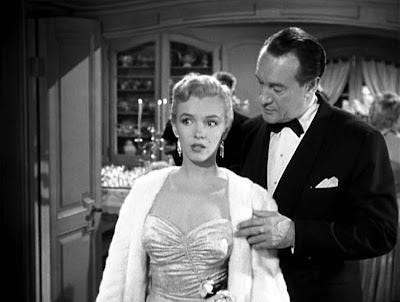
My one slight regret about the Sight and Sound article is that I didn’t have room to mention what’s actually my favorite line from Miss Casswell in All About Eve. I will always have a special place in my heart for Monroe, after a disastrous audition, swanning out of the ladies, shall we say, lounge and murmuring, when George Sanders asks how she feels, "Like I just swam the English Channel." It’s hysterically funny, but if I think about it, the scene takes on a little poignance. Surely Marilyn’s years of knocking around Hollywood’s bottom rungs—auditioning, posing, dealing with (shudder) Hollywood men—are right there in Miss Casswell’s weary strut across the lobby.
In fact, it’s wrong to say that I’ve gained admiration only for Marilyn’s acting. I’ve also grown to love her as a person. Troubled and often sad, yes, aren’t we all. But there was something immensely lovable about Marilyn, and it’s not related to the desire to protect her or rescue her or whatever some (mostly male) writers like to bang on about. Rather, it’s a sense we have that she could be your friend. A good friend who would listen and have your back. That’s the Marilyn that Susan Strasberg and Shelley Winters described. It’s also at least part of what I think Kim means when she calls Marilyn “L.A.’s beloved daughter, our sacred sister.” I love that.
Put in prosaic terms: Marilyn was a good egg. I can think of few better illustrations of that than a passage from Norma Barzman's 2003 memoir, The Red and the Blacklist. I excerpted this passage on my original blog all the way back in 2010, but I have a lot more to say, so here we go again.
Barzman wrote the original stories for the underrated 1946 romantic comedy Never Say Goodbye, as well as the high-wire act of multiple nesting flashbacks in the story for The Locket (also 1946). But Barzman wasn’t able to work on much more than that for many years, for reasons she spends much of her narrative explaining. She was married to left-wing screenwriter Ben (The Boy With Green Hair, Give Us This Day, El Cid) with whom she had seven (!) children. Together they were blacklisted from 1949 to 1976 and lived in exile in Britain and France. Norma Barzman’s book is one of the best personal accounts of the era—an up-close view of how the blacklist began, gained steam, and eventually flattened the Barzmans and most of their friends.
(“Farran,” I hear you say gently, or perhaps quite loudly. “This is a Marilyn post. Did you forget?” I’m getting to it, I promise.)
In a chapter candidly called "The Shit Hits the Electric Fan," Norma talks about an unbearably hot night in Los Angeles in the summer of 1947. The House Un-American Activities Committee had the Hollywood Ten in its sights. The Barzmans’ friends in the Committee for the First Amendment have returned from Washington with little to show but press clippings. The blacklist is on the horizon. Everyone in town can feel it.
Norma has gone out on the lawn in search of a breeze and Ben, sporting a sombrero and a loud print shirt acquired on vacation in Acapulco, joins his wife. They sip gin-and-tonics, but it’s hard to relax. For one thing, cars keep slowing down in front of their house while the occupants take a good long look. It’s odd. The Barzmans are by no means famous.
Neighbor Groucho Marx breezes by, wearing a pith helmet and pushing baby daughter Melinda in a pram. Groucho stops to announce to Norma that it's awfully hot: "Of course, it's doubly hot for you—with two kinds of heat. But don't ask me for anything more than ice cubes, which is as far as my sympathies go."
The Barzmans are still attempting to decode this when an outdated white Cadillac convertible pulls up, top down and “a swirling mass of golden wind-tossed hair” behind the wheel. Out steps a lovely young girl they've never seen before. She shimmers over to the couple and remarks that she's on her way to a party at the Minnellis up the street because her agent said “it would be good for me to show myself.” But then she saw Ben and Norma out on the lawn with their drinks—and gee, the sombrero looked fun. Would somebody get her a drink?
I'd venture to say that even now, a woman who looks like Marilyn Monroe could still get a gin and tonic from a random stranger at a moment's notice. Ben leaps up and fetches her the drink (hard not to imagine her responding with a variation of "Thank you, Mr. Fabian"). She takes a sip, pronounces it fine (apparently it was her first G&T). Then she starts to talk. Well, ramble mostly. About the importance in Hollywood of having a signature drink, and did the Barzmans think a gin and tonic would work for her? The girl swerves from this topic to Murphy's Law, which Norma hasn't heard of. The girl says her mother always told her not to be the one to bring bad news, on account of Murphy's Law.
“You were trying to make up your mind whether or not to tell us something unpleasant?” I prompted.
“Don't you know?” she asked hopefully. We shook our heads. She took a deep breath. “There's a deputy sheriff's car with two cops at the bottom of this hill. They’re stopping practically every car coming up the hill. There was this guy in front of me and the deputy stopped him so suddenly I almost hit him. I was really upset. Then I hear the deputy ask the guy where he was going? Was he going to your address by any chance?”
“Our address?” I asked incredulously.
“I heard it loud and clear. The guy said no and the cop waves him on. Then I drove up. ‘You stopped that guy so suddenly I almost crashed into him.’ The cop says in that way I hate—I seem to bring it out in most guys—‘Lady, I wouldn't have stopped you,’ then he grins a big fat grin and says, ‘I sure would’ve, if I’d had an excuse.’ Well, to make a long story short, he leans over me, he’s a really big guy, and says, ‘You don't happen to be going to 1290 Sunset Plaza Drive?’ ”I gasped.
“ ‘No, I don't,’ she said. “That’s your number, isn't it?” It was. “What's going on? Is there a murder or something?”
The ground had slipped from under me in one of those near Los Angeles land-shifts. I guessed what was coming.
The girl went on. “ ‘The sheriff's office is keeping an eye on the house. Subversive groups are meeting there.’ Well, sir, I really blew. I said, ‘Who the hell is this sheriff of yours? Hitler?’ Gee whiz. Subversive? With that sombrero?”
I moved closer to Ben. “You mean he's told everybody on this hill we’re subversive?”‘So what did the deputy sheriff do finally?’ Ben asked.
“Oh, he gave me a ticket for obstructing traffic,” the girl said. “My mother was right. There’s no percentage in being the one who brings lousy news.”“I think I know why the sheriff’s car is doing that,” Ben said. “A bunch of us, screenwriters and directors, were going to meet to discuss what to do to help the Hollywood Ten. The Committee for the First Amendment—the one Humphrey Bogart resigned from? The meeting was called off this morning—”
“Somebody must have forgotten to call off the sheriff,” the girl said. “I bet if you gave it a little thought, you could figure out who that was.”
“Right now I don’t want to know,” I said. “It might be a friend.” The girl rose and stood there in an odd posture.
“My name is Norma,” I said, getting up and extending my hand.
“Gee, my name is Norma, too,” she said, and we shook hands all around. “I’m glad I stopped in on you guys. I mean, I hoped there was somebody kind of behind the scenes worrying about things, not just letting them get away with all the stuff they do to us. A struggling young actress like me knows about that. I’m real glad there’s people like you trying to figure out ways of not getting pushed around. I don’t care what you are. I like it that there’s somebody watching the store. I think I’ll sleep better tonight.” She turned toward her car.
“Thanks,” Ben called after her.
I’ll let the late David Ehrenstein wrap things up. When I posted this tale at the old blogspot, the first comment was his: “Don’t you just love her to teeny little bits?”
Yes, David. I do.


Goodness, that is a FASCINATING story, and is excellent evidence towards your point that Marilyn, who endured more pressure and aggressively sexualized attention (which was sadly excused because she was seen as an entity that belonged to everyone) than perhaps anyone in the 20th century, would indeed have been a great friend to have. Imagine all those cars slowing down - and she was the only one brave enough to stop and actually get to know the people the police were cautioning others about. Her having that level of curiosity AND courage is more evidence as well of her intelligence and decency, which is also so sadly overlooked. I think one of the saddest examples of how she was treated can be heard in an actual audio clip - some reporter for some rag back in the era was a three-day celebrity because she had managed to squirrel some truly personal details out of Marilyn during an interview. The reporter is being asked about it on the audio clip by Edgar Bergen, and he keeps laughing and making lascivious comments as this woman talks proudly about how she tricked Marilyn - "...and then I put my pencil down, making her think the interview portion was over, and then asked, 'So Marilyn, tell me...'" It's stomach churning, as is Bergen's delight over how Marilyn was tricked. I much prefer to hear how the great Jack Benny treated her when she did that spectacularly fun and funny appearance on his show, the one and only time she did scripted television. Jack Benny declared to one and all that Marilyn had the true gift for comedy. It's especially touching at the end of the episode when you see Marilyn drop her persona briefly, and just be herself as she enjoys being with Jack. Thank you for this beautiful essay - I will definitely go get a copy of Sight and Sound! (I managed to eat at Musso and Frank Grill once, and our waiter told us (after I asked!) that Marilyn really enjoyed the table we were currently sitting at. Was it true? Don't know - but as Steve Martin says at the end of L.A. Story, "A kiss may not be the truth, but it is what we wish were true.")
I remember the day after my tenth birthday because I was allowed to ride my bicycle all the way to the local store and then I heard about Marilyn's death.
My mother wondered why I was so upset and I didn't know how to tell her. But as a child I was convinced that if I became her friend, everything would be better for her. (see also "Candle in the Wind")